
Why do organizations with mature ERP systems still struggle to make timely, confident business decisions?
In 2026, most enterprises run on stable, integrated, and trusted ERP platforms as systems of record. These platforms manage orders, finances, supply chains, and compliance with precision. Yet despite this maturity, decision-making inside organizations often remains slow, manual, and fragmented. Leaders still rely on spreadsheets, meetings, and judgment calls to interpret what ERP data actually means for the business.
The challenge is not data availability. ERP systems capture massive volumes of accurate information. The challenge is interpretation. ERP platforms were designed to record transactions and enforce rules, not to explain what action should be taken next in a changing business context.
As organizations push toward faster execution and higher accountability in 2026, this gap becomes more visible. Decisions increasingly need to be made in real time, across teams, and with incomplete information. ERP data alone cannot support that demand by itself.
This is why many enterprises are now recognizing the need for an additional capability between ERP data and business decisions. That capability is the missing enterprise intelligence layer, designed specifically to translate data into decision-ready insight.
Understanding why this layer is needed requires examining how ERP systems actually operate today.
Why does ERP data still fail to answer the most important business questions?
ERP systems excel at capturing what happened. They record transactions, enforce process steps, and maintain consistency across operations. However, they are not designed to understand why something happened or what should happen next. That distinction matters far more in 2026 than it did in the past.
Business environments have become more dynamic. Decisions now span multiple systems, teams, and constraints. A single operational decision may depend on customer impact, risk exposure, policy limits, and timing considerations that ERP data does not represent directly.
In practice, this creates a gap between ERP data and operational decision-making. ERP platforms show status but do not convey urgency. They enforce rules, but they do not evaluate trade-offs. They support workflows, but they do not prioritize actions based on business intent.
As a result, people fill the gap manually. Teams interpret reports, combine data from different tools, and apply judgment outside the system. This slows execution and introduces inconsistency.
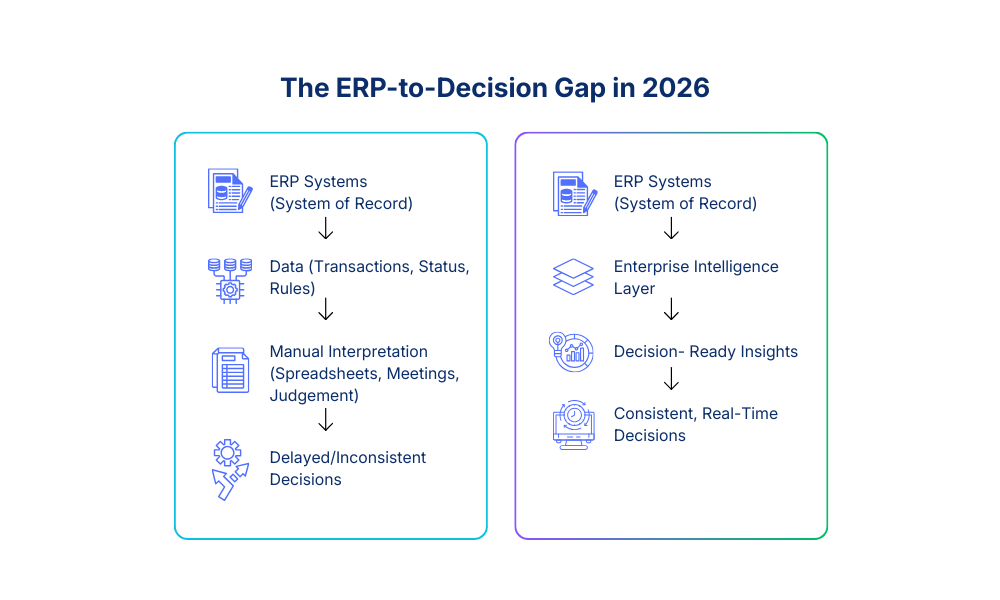
In 2026, organizations are recognizing that dashboards and reports alone are not enough. They need systems that understand decision context, not just data structure. This shift marks a move from data management to enterprise decision support.
Recognizing this limitation sets the stage for understanding what the missing intelligence layer must provide.
What actually turns ERP data into actionable business judgment?
The missing intelligence layer is not another reporting tool or analytics dashboard. It is a capability that sits between ERP systems and operational decisions, designed to interpret data in the context of business.
This enterprise intelligence layer focuses on how decisions are made, not just how data is stored. It understands decision rules, priorities, and constraints, and applies them consistently across workflows.
At a practical level, this layer performs several critical functions:
This capability does not replace ERP systems. It complements them by focusing on decision logic rather than transaction processing.

In 2026, organizations that adopt this approach move beyond static reporting toward a decision intelligence architecture that delivers faster, more consistent outcomes.
Designing this layer correctly is essential, especially when scaling across the enterprise.
How should organizations structure this layer to scale without breaking trust?
The most successful intelligence layers in 2026 are designed around decisions, not technology components. Architecture follows responsibility and operational flow, not just data pipelines.
A key design principle is that decisions must be owned. Every decision supported by the intelligence layer has a clear business owner accountable for the outcomes. This ensures that intelligence does not become optional advice that teams ignore.
Another principle is that intelligence operates inside workflows, not alongside them. Decision support appears when action is required, not after the fact. This integration reduces delays and prevents rework caused by disconnected systems.
Design also emphasizes explainability. Users must understand why a recommendation was made, especially when decisions affect customers, cost, or risk. This transparency builds confidence and encourages adoption.
Organizations often struggle when they treat intelligence as an extension of analytics. Analytics describe patterns. Intelligence supports choices. That difference shapes architecture decisions.
From a technical perspective, the layer relies on reusable components that can support multiple decisions. From a business perspective, it aligns with how teams already work.

In 2026, this approach supports enterprise AI architecture that is scalable, accountable, and adaptable without constant rework.
Once designed, the real challenge becomes operating this intelligence reliably in production.
Building Agent-Driven Digital Platforms with AI Gateways and Modern API Architecture
Why does decision intelligence perform well in testing but struggle in real operations?
Because real operations are unpredictable.
In production, systems must handle incomplete inputs, policy changes, and edge cases. This is not a failure of technology. It is the reality of enterprise environments.
Organizations that succeed in 2026 treat decision intelligence as a living system. They expect conditions to change and plan for disagreement, correction, and evolution.
Three operational controls are essential:
This is where many organizations misunderstand scaling. Scaling is not adding more use cases. Scaling is running more decisions through the system while maintaining control and consistency.
This operational discipline reflects true AI governance readiness, even when the intelligence layer is not branded as AI.

By 2026, trust becomes the defining factor. The best systems are not the most advanced. They are the ones people rely on under pressure.
This realization leads to a broader strategic insight.
What separates organizations that extract value from ERP data from those that struggle?
The difference lies in how effectively they connect data to decisions.
In 2026 and beyond, enterprise maturity is measured by decision quality, not system uptime. Organizations that invest in an intelligence layer move from reacting to data toward acting with confidence.
They reduce delays, improve consistency, and create accountability around decisions that matter most. ERP systems remain essential, but they are no longer expected to do everything.
The missing intelligence layer bridges the gap between facts and judgment. It enables organizations to operate faster without losing control.
For organizations seeking to design and operate this layer responsibly, experienced partners can accelerate the journey. An AI consulting company helps businesses build decision-focused intelligence capabilities that align technology with real business outcomes.

Article By Vivek Kumar Upadhyay
Accelerate your business with AI designed for you
More Blog Posts
Services
Industries
Resources
Company
Government (Contracts)

Futran Solutions is an Equal Opportunity Employer
We do not discriminate based on race, color, religion, sex, national origin, age, disability, veteran status, or any other legally protected status.


